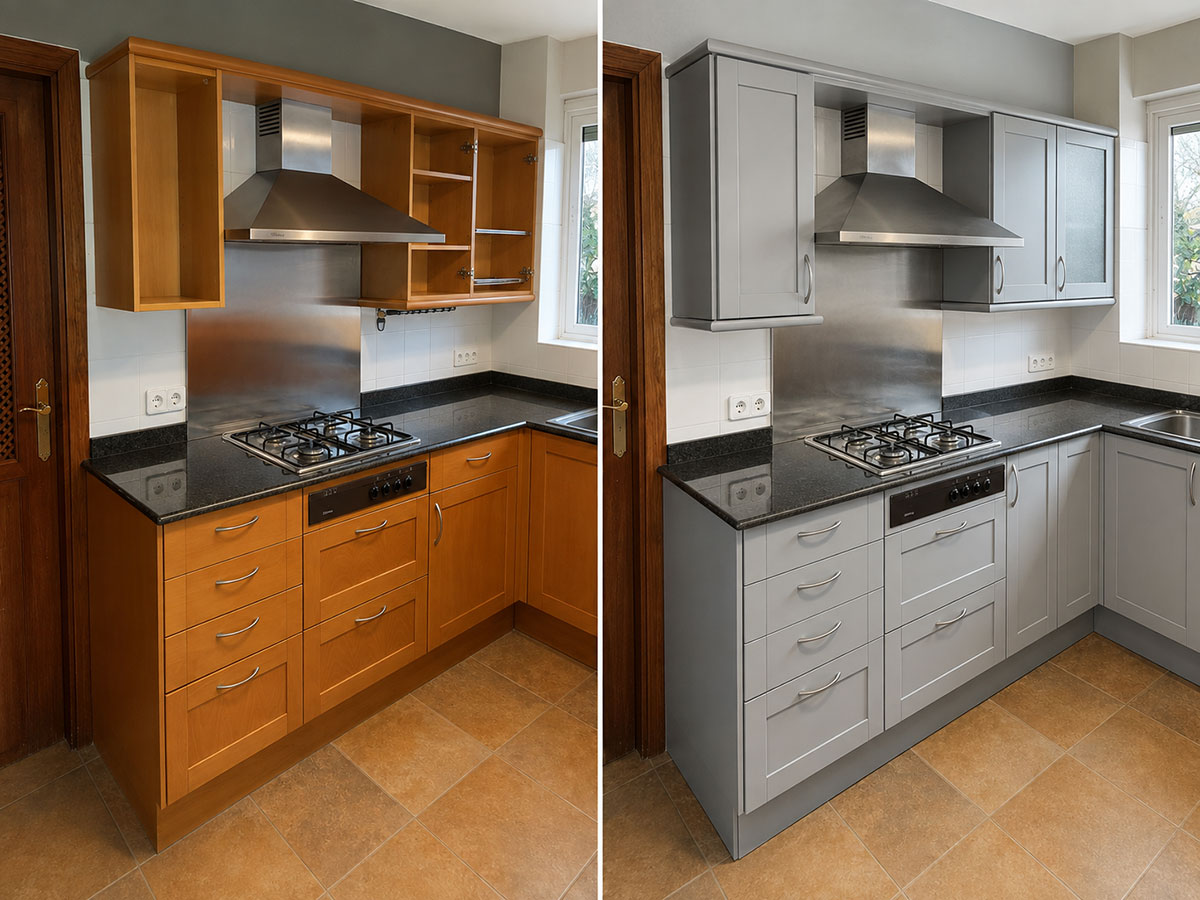
Replacing an entire kitchen is not always necessary. In many cases, the cabinets are still functional, the layout remains practical and the main issue is simply aesthetic: dark doors, outdated finishes, worn drawer fronts or colours that no longer fit the style of the home.
In these situations, kitchen cabinet lacquering can be a very interesting alternative. It allows you to renew the look of your kitchen without replacing all the units, avoiding a more expensive, longer and more disruptive renovation.
In Mallorca, where many homes combine older kitchens with structures that can still be used, lacquering the cabinets can completely transform the space. The final result does not depend only on the chosen colour, but also on the condition of the surface, the preparation work, the product used and the application process.
Renewing your kitchen without replacing all the cabinets
A kitchen can look old without actually being in poor condition. Sometimes the doors close properly, the drawers work, the worktop is still usable and the layout remains practical. But the colour of the doors, the glossy finish, the dark wood or the accumulated wear can make the whole kitchen look much older than it really is.
Lacquering allows you to work precisely on the most visible part of the kitchen: doors, drawer fronts, visible side panels, mouldings and other elements that define the appearance of the space. With the right finish, a traditional kitchen can become brighter, more up to date and better integrated with the rest of the home.
It is not a matter of simply “giving the cabinets a coat of paint”. Good lacquering requires dismantling, preparation, sanding, repairs, applying primer where necessary and working with suitable products to achieve a resistant and uniform finish.
When is it worth lacquering kitchen cabinets?
Kitchen cabinet lacquering is worthwhile when the structure is in good condition and the main objective is to update the appearance. In other words, when the units are not deformed, the doors close properly and there are no serious problems with moisture or swelling.
It is also a good option when the kitchen layout works well. If you do not want to change the position of the cabinets, cooking area, sink or appliances, lacquering can be a more reasonable solution than removing everything.
However, if the cabinets are badly deteriorated, there are loose pieces, edges swollen by moisture or the layout is no longer practical, it is worth considering whether lacquering is the right option or whether a more extensive renovation would make more sense.
This initial assessment is important. Lacquering a kitchen in poor condition may improve its appearance for a while, but it will not solve structural problems in the furniture.
Which parts of a kitchen can be lacquered?
Many visible parts of kitchen furniture can be lacquered. The most common elements are cabinet doors and drawer fronts, as they have the greatest visual impact. Visible side panels, plinths, mouldings, display cabinets, shelves and auxiliary units can also be lacquered, provided the surface is suitable.
Each kitchen must be assessed individually. Not all materials respond in the same way and not all finishes require the same preparation. A solid wood door, a veneered surface, a melamine cabinet or a previously varnished finish may all need different treatments before the lacquer is applied.
That is why, before preparing a quote, it is important to check the condition of the cabinets, the type of surface, the adhesion of the existing finish and any knocks or defects. Good preparation is what makes the result not only attractive at first, but also long-lasting.
How we work on kitchen cabinet lacquering
The process begins with an assessment of the kitchen and the cabinets to be lacquered. At this stage, we check the condition of the doors, fronts, hinges, side panels and any element that may affect the final result.
Once the work is confirmed, the doors and fronts are usually removed so they can be worked on with greater comfort and precision. The pieces that can be transported are lacquered in the workshop, where it is easier to control preparation, application and drying. Fixed elements or parts integrated into the kitchen are worked on in the home, with proper protection for the areas that should not be affected.
Before applying the lacquer, the pieces must be thoroughly cleaned and degreased. In a kitchen, this step is essential, as cabinets often accumulate grease, steam, cleaning product residue and invisible dirt that can affect adhesion.
The surface is then sanded, small defects are repaired with suitable fillers when necessary, and the appropriate primer is applied. Only then does the final finish begin.
At Pintures i Lacats Toni Planas, we place great importance on this preparation. Kitchen cabinet lacquering is not just about changing the colour, but about achieving a uniform, resistant and well-finished surface.
Why lacquering is not the same as painting kitchen cabinets
Many people search for “painting kitchen cabinets in Mallorca” because it is the most common way to express what they need. However, in professional work, it is usually more accurate to talk about lacquering.
The difference is not only in the product. It is also in the process, the surface preparation, the method of application and the final finish.
Painting can be understood as a simpler application, often done directly on the cabinet with a roller or brush. It may work for occasional decorative solutions, but it does not always provide the resistance or uniformity that a kitchen requires.
Lacquering, on the other hand, aims for a finer, more homogeneous and more durable finish. It requires proper surface preparation, suitable products and control over each stage of the process. In a kitchen, where cabinets are touched every day and exposed to grease, humidity, heat and frequent cleaning, this difference matters.
That is why, even if the client talks about painting kitchen cabinets, the service we provide is professional lacquering.
Advantages of lacquering a kitchen instead of replacing it
Lacquering kitchen cabinets can create a very visible change without the need to dismantle the whole kitchen. The main advantage is that it allows you to make use of what is already there when the cabinets are in good condition.
It also reduces the duration and disruption of the work. Replacing an entire kitchen involves building work, measurements, manufacturing, removal of existing furniture, installation and, in many cases, several trades working at the same time. Lacquering is a more contained intervention, especially when the kitchen structure remains in place.
Another advantage is aesthetic freedom. You can choose a more current colour, a brighter finish or a combination that works better with the floor, worktop, walls or a wider interior painting project in Mallorca. In older kitchens, moving from dark tones to whites, soft greys or neutral colours can completely change the perception of the space.
In addition, renewing instead of replacing also makes sense from a practical and sustainable point of view. If the cabinets still work, extending their useful life avoids unnecessary waste and reduces the use of new materials.
What to consider before lacquering kitchen cabinets
Before lacquering a kitchen, it is important to understand that the final result will depend greatly on the initial condition. If there is accumulated grease, knocks, lifted edges or deformed doors, it will be necessary to assess what can be corrected and what limitations exist.
It is also worth thinking carefully about the colour. A white kitchen can bring in a lot of light, but it is not always the only option. Sand, stone, soft grey, muted green or warm tones can work very well depending on the style of the home.
Another important point is organisation. To lacquer kitchen cabinets, it will usually be necessary to empty the inside of the units that need to be handled or removed. The kitchen should also be cleared of items that may make the work more difficult.
Good planning helps avoid inconvenience and allows the work to be carried out with greater safety and cleanliness.
Frequently asked questions about kitchen cabinet lacquering
Can old kitchen cabinets be lacquered?
Yes, provided they are in good structural condition. Before lacquering, it is important to check doors, fronts, edges, hinges and areas affected by moisture or grease.
Is it better to lacquer or replace kitchen cabinets?
It depends on the condition of the kitchen. If the layout works and the cabinets are in good condition, lacquering can be a very interesting solution. If the units are deformed, swollen or badly deteriorated, it may be worth considering a more extensive renovation.
What is the difference between painting and lacquering kitchen cabinets?
Although many people talk about painting kitchen cabinets, lacquering is a more technical process. It involves preparing the surface, applying suitable primers or products and achieving a more uniform and resistant finish.
Do kitchen cabinets need to be emptied?
Yes, it is usually necessary to empty the cabinets that are going to be handled or removed. It is also advisable to clear the kitchen to make the work easier and to protect the area properly.
Are the doors lacquered at home or in the workshop?
Whenever possible, doors and fronts are removed and worked on in the workshop. Fixed elements or parts that cannot be transported are treated in the home, with the necessary areas properly protected.
How long does it take to lacquer a kitchen?
It depends on the number of doors, fronts and side panels, as well as the condition of the cabinets. It also depends on whether repairs are needed or fixed parts have to be worked on inside the home. The best option is to assess each kitchen before giving a fixed timeframe.
Can I choose any colour?
In most cases, you can choose from a wide range of colours and finishes. The final choice should take into account the light in the kitchen, the style of the home, the worktop, the floor and the daily use of the space.