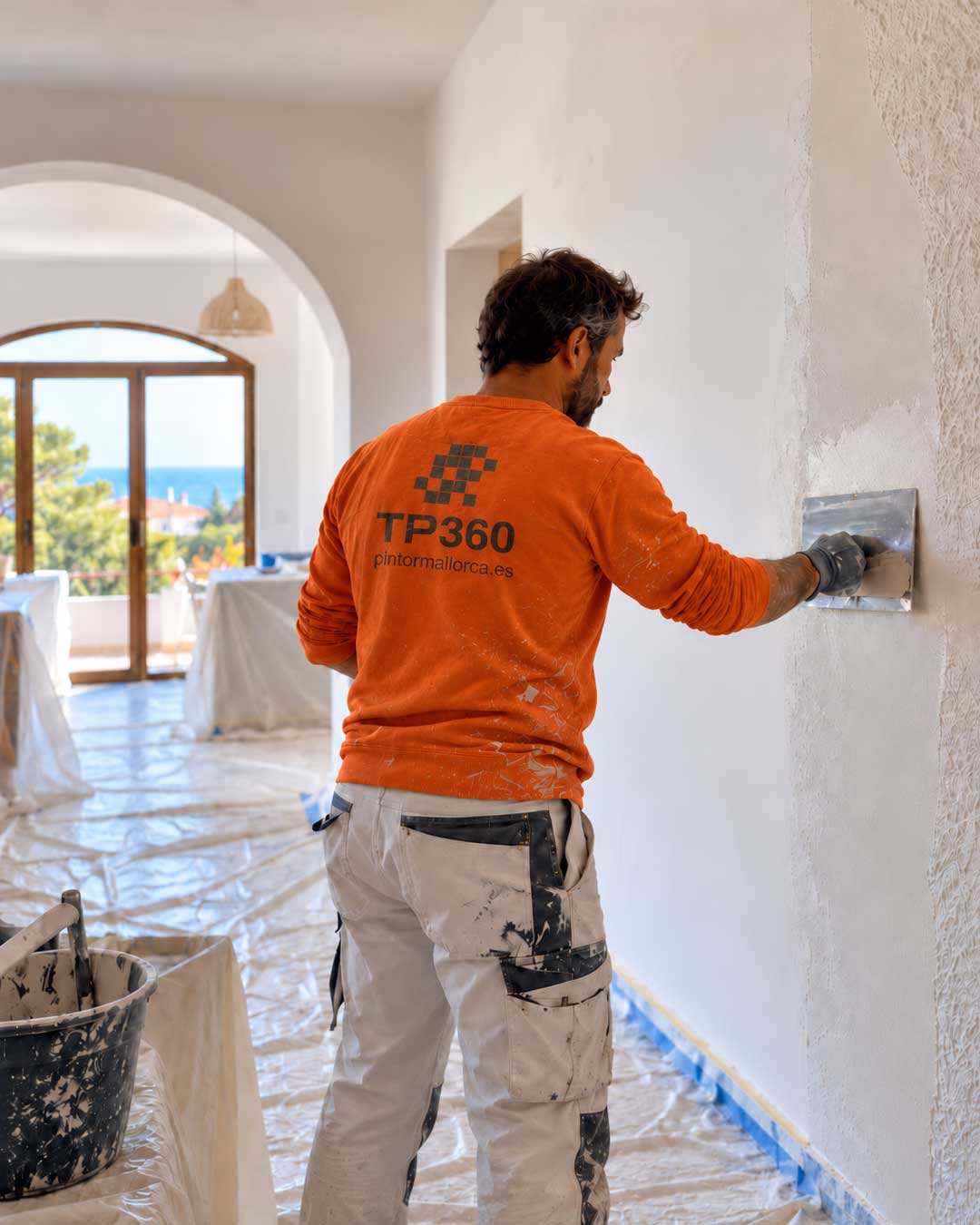
Removing gotelé is still one of the most requested improvements in older homes. Many houses and flats built years ago still have rough textured walls, uneven finishes or gotelé applied in living rooms, hallways, bedrooms and ceilings. Although it was once a very common solution, today many homeowners prefer smooth walls that look cleaner, more contemporary and easier to integrate into a modern home.
The problem is that removing gotelé and smoothing walls is not as simple as it may seem. It is not just a matter of scraping the wall and painting over it. To achieve a fine, long-lasting finish, it is first necessary to assess the type of gotelé, the condition of the surface, the existing paint, previous layers and the level of finish required.
In Mallorca, and especially in older flats in Palma, it is very common to find walls with plastic-painted gotelé, distemper, accumulated layers of paint or surfaces that need repairing before they can be made completely smooth. That is why, before requesting a quote, it is worth understanding what the job really involves and which factors influence the price.
Why removing gotelé can transform a home
Gotelé has a major impact on the appearance of a home. It can make walls look dated, make clean decoration more difficult and reduce the sense of brightness, especially when combined with dark colours or ageing paint.
Smoothing the walls makes it possible to update a home without carrying out a full renovation. A smooth wall improves the feeling of space, makes it easier to use more current colours and gives living rooms, bedrooms, hallways and communal areas a more carefully finished appearance.
Removing gotelé is also a good opportunity to check the general condition of the walls. Once work begins on the surface, cracks, dents, hollow areas, flaking or poorly finished old repairs may appear. Correcting these issues before painting helps ensure the final result is not only better looking, but also more durable.
Removing gotelé is not just scraping the wall
One of the most common assumptions is that gotelé can simply be scraped off. Sometimes it can, but not always. The method depends largely on the type of gotelé and the paint applied over it.
When the gotelé is distemper-based, it is usually easier to dampen and remove. However, when it is covered with plastic paint, the job becomes more complicated. The paint creates a more resistant layer that can prevent water from penetrating properly, which means scraping directly can be slow, messy and ineffective.
In many cases, the best solution is not to remove all the texture down to the original surface, but to cover and level the wall with suitable products, then sand, refine and prepare it for painting.
That is why each home should be assessed before deciding on the system. Not all gotelé is removed in the same way, and not all walls can be treated using the same method.
Smoothing walls: the part that really defines the finish
Removing gotelé is only part of the job. What really determines the quality of the result is the wall smoothing process.
Once the texture has been removed or covered, the necessary layers of filler, smoothing compound or levelling product must be applied to regularise the surface. The wall is then sanded, checked under light, corrected where needed and refined again until a uniform finish is achieved.
This process requires patience. A wall may appear smooth at first glance, but when it receives side light or is painted in certain tones, any mark, wave or defect becomes much more visible. That is why the smoothing work must be done carefully, especially in rooms with plenty of natural light, long corridors or large wall surfaces.
A good smoothing job is not only appreciated when the wall has just been painted. It is noticeable over time, when the paint maintains a clean appearance and patch marks, poorly sanded areas or visible imperfections do not start to appear.
Removing gotelé and smoothing walls in Palma
In Palma, it is common to find homes with gotelé in older flats, partially renovated apartments or houses that still retain their original finishes. In many cases, the client is not looking for a full renovation, but simply wants to update the appearance of the property before moving in, renting it out, selling it or repainting the interior.
In these situations, removing gotelé and smoothing walls can be a very effective intervention. It completely changes the perception of the home and allows the walls to be finished with more contemporary paint, neutral colours or cleaner decorative finishes.
However, the work must be planned properly. If the property is furnished, floors, doors, windows, furniture and circulation areas need to be protected. If the property is empty, the work is usually more agile, but it still requires order, cleanliness and proper dust management.
Can gotelé be removed without dust?
This is one of the most frequent questions. The realistic answer is that dust can be greatly reduced, but it cannot always be eliminated completely.
The process of smoothing walls usually involves sanding. And where there is sanding, there is dust. The difference lies in how the work is organised: protecting the home, using suitable tools, extraction, closing off areas, progressive cleaning and taking care during the finishing stages.
Talking about “dust-free gotelé removal” may sound attractive, but it depends heavily on the system used, the condition of the wall and the level of finish required. In professional work, the important thing is to minimise disruption and protect the home properly, rather than promise something that may vary from one case to another.
If the home is occupied, this point is particularly important. The job should be planned by areas, with proper protection and as little impact as possible on day-to-day life.
Price of removing gotelé: what affects the cost
The price of removing gotelé can vary greatly from one property to another. It does not depend only on square metres, but also on the actual condition of the walls and the system required to achieve a correct finish.
Factors include the type of gotelé, whether it is painted with distemper or plastic paint, ceiling height, the condition of the surface, the amount of repair work required, whether ceilings are also included, whether the property is furnished or empty, and the type of final paint.
Smoothing the walls of a small, empty room is not the same as doing the whole of a furnished flat with ceilings, narrow corridors, damaged walls and several old layers of paint.
The level of finish must also be taken into account. A smooth wall for a standard matt paint does not require the same preparation as a surface highly exposed to side light or prepared for more demanding finishes. The finer the expected result, the more important the checking, sanding and correction process becomes.
That is why, although many people search for “price to remove gotelé” or “cost of smoothing walls”, the most sensible approach is to assess the property before giving a fixed figure.
How much does it cost to smooth walls in Mallorca?
To calculate how much it costs to smooth walls in Mallorca, the best option is to inspect the property and define the exact scope of the work. It is not enough to know the square metres of the flat. It is necessary to see how many walls have gotelé, whether ceilings are included, what type of texture there is, what condition the existing paint is in and what final finish is required.
In some cases, the client only wants to remove gotelé from the living room and hallways. In others, the whole property is treated. There may also be areas with thicker gotelé, walls with old repairs or rooms where the surface is in worse condition.
A preliminary visit makes it possible to detect these details and prepare a more realistic quote. This helps avoid surprises during the work and allows the client to understand what is included: protection, preparation, smoothing, sanding, primer if required, final painting and cleaning.
What paint should be applied after removing gotelé?
Once the walls are smooth, the choice of final paint also matters. There is little point in carrying out good smoothing work and then finishing it with a paint that is not suited to the use of the room.
In homes, interior plastic paints with good coverage, washability and a uniform finish are commonly used. In high-traffic areas, such as hallways, entrances or children’s rooms, a more resistant paint may be advisable. In bedrooms or living rooms, a matt or satin finish is often chosen to create a more elegant look.
Choosing the right colour is also important. Smooth walls reflect light differently and make shadows more visible, so it is worth considering the whole space: flooring, woodwork, furniture, natural light and the style of the home.
If the smoothing work forms part of a wider interior painting project in Mallorca, it may be a good moment to renew the entire look of the home with a coherent colour palette.
Common mistakes when removing gotelé
One of the most common mistakes is starting the job without checking what type of gotelé is on the wall. If the wrong system is used, the process can become longer, messier and less effective.
Another frequent mistake is not preparing the surface properly. Painting over a poorly smoothed wall can leave visible marks, areas with different levels of absorption or defects that are especially noticeable under light. It can also happen that primer is not used when the surface needs it, affecting both the finish and paint consumption.
Lack of protection is another major issue. Removing gotelé and smoothing walls generates movement, dust and material residue. If floors, doors, windows, sockets, furniture and circulation areas are not properly protected, the work can become far more disruptive than necessary.
Finally, rushing the process should be avoided. Drying times, sanding and checking are all part of the job. Skipping stages in order to finish sooner usually compromises the final result.
Painters for removing gotelé and smoothing walls
Removing gotelé and smoothing walls requires skill. The difference between a quick job and a professional finish lies in preparation, control of the surface and the final check before painting.
At Pintures i Lacats Toni Planas, we assess the condition of the walls before defining the working system. We check the type of gotelé, the existing paint, possible defects and the conditions of the property in order to propose the right solution.
We work both in empty properties and occupied homes, protecting the necessary areas and organising the process to reduce disruption. The aim is not only to remove the texture, but to leave a smooth, stable base ready for long-lasting interior paint.
Smoothing walls can transform a home, but only if it is done well. That is why, before deciding based on price alone, it is important to assess what the quote includes and what level of finish is expected.
Frequently asked questions about removing gotelé and smoothing walls
How much does it cost to remove gotelé?
It depends on the type of gotelé, the square metres, the condition of the walls, whether ceilings are included, whether the property is furnished and the final finish required. The best option is to assess the home before giving a fixed price.
Is it better to remove gotelé or cover it?
It depends on the type of gotelé and the condition of the wall. In some cases it can be removed; in others, it may be more effective to level the surface with suitable products before sanding and painting.
Can gotelé be removed without dust?
Dust can be greatly reduced with good planning, protection and suitable tools, but it is not always possible to eliminate it completely because smoothing work usually requires sanding.
How long does it take to remove gotelé and smooth walls?
It depends on the size of the property, the number of rooms, the condition of the walls and the drying times between stages. A well-executed job must respect the preparation, application, sanding and painting times.
Can gotelé be removed in a furnished home?
Yes, although it requires more protection and organisation. Furniture, floors, doors and circulation areas need to be covered, and in some cases it is advisable to work in phases to reduce disruption.
What paint should be used after smoothing walls?
It depends on the use of the room and the desired finish. In interiors, quality plastic paints that are washable and provide good coverage are commonly used. In high-traffic areas, a more resistant paint may be advisable.
Is it worth removing gotelé before selling or renting a property?
In many cases, yes. It significantly updates the look of the home. Smooth walls usually create a more modern, clean and well-maintained impression, which can help improve the perception of the property.