
Mallorcan shutters are part of the identity of many homes. They protect from the sun, regulate the amount of light entering the house, provide privacy and give character to façades, village houses, renovated homes and traditional buildings.
They are also one of the exterior elements that suffer the most. They are exposed all year round to sun, humidity, wind, salt air, dust and temperature changes. Over time, wood dries out, colour loses intensity, paint cracks, flaking appears and the slats start to show signs of deterioration.
Restoring Mallorcan shutters is not a quick or simple task. At first, it may seem like a matter of sanding and painting, but in practice it requires patience, preparation and technical judgement. Every slat, edge, joint and corner needs attention. That is why, to achieve a durable result, it is not enough to apply a new product: the shutter must be properly prepared and the right system chosen according to the material and the desired finish.
Why restoring Mallorcan shutters is so labour-intensive
Mallorcan shutters are not flat surfaces. Their structure of slats, gaps, edges and moving parts makes the work much more complex. Sanding a smooth door can be relatively quick; sanding a Mallorcan shutter means working area by area, going over narrow spaces where old paint, dust, deteriorated varnish or dirt have accumulated.
If this preparation is done superficially, the new product may not adhere properly. The finish may look good at first, but it can lift, crack or lose adhesion sooner than expected.
The condition of the shutter also matters. A wooden shutter that has only lost colour is not the same as one with flaking paint, cracks, dry areas, rusty screws or parts weakened by humidity. In some cases, cleaning, sanding and applying a new protection system is enough. In others, small repairs, replacing elements or more in-depth preparation may be needed before the final finish.
Application also requires precision. The slats force you to control the amount of product very carefully to avoid build-up, drips, marks or uncovered areas. That is why many people start by trying to paint Mallorcan shutters themselves and soon discover that the job requires more time, tools and experience than they expected.
Checking the material and condition before starting
Before deciding on the finish, the real condition of the shutter needs to be assessed. This review helps determine whether it is best to keep the wood visible, apply an opaque enamel or renew an aluminium shutter with a specific system.
On wooden shutters, it is important to check whether the substrate is sound, whether there are open areas, knocks, humidity, remains of varnish or old layers of paint. It is also necessary to check whether the slats are firm, whether there are loose parts and whether the shutter still moves correctly.
On aluminium shutters, the problem is usually different. Many aluminium Mallorcan shutters have been installed in recent years because they require less maintenance than wood. Even so, over time they can lose colour, show surface wear or need an aesthetic renewal to fit better with the façade.
Not all shutters should be treated in the same way. The material, the condition of the substrate and the finish you want to achieve all determine the working system.
Open-pore treatment for wooden shutters
When the shutter is made of wood and you want to preserve its natural appearance, a good option is to apply an open-pore product. This system keeps the wood visible and protects it without creating a closed film on the surface.
The product penetrates the substrate and helps the wood breathe, which is especially important outdoors, where humidity and temperature changes continually affect the material. It is a suitable solution when the wood is in good condition, has aesthetic value or when you want to maintain a warmer, more natural appearance.
For it to work properly, preparation is essential. The surface must be cleaned, sanded and stripped of any previous products that could prevent the treatment from penetrating. If the shutter had old layers of varnish or paint, more intensive work may be needed before applying the new finish.
The advantage of an open-pore system is that it respects the texture of the wood. Instead of hiding the substrate, it protects and enhances it. It also allows for maintenance that is more in line with the natural behaviour of exterior wood and with other exterior wood protection work.
Enamelling wooden shutters with polyurethane
Another option is to apply a two-component polyurethane enamel. This system is used when you want an opaque, resistant and uniform finish, usually in white, green, grey, brown or other tones adapted to the façade.
Unlike an open-pore finish, enamel covers the wood and creates a more closed protective layer. It is an interesting solution when the shutter has already been painted, when you want to completely change the colour or when the wood has tone differences that you do not want to leave visible.
Two-component polyurethane offers high resistance and a professional finish, but it requires careful application. It is not enough to paint over the existing surface. The shutter must be properly sanded, repaired and prepared so that the enamel adheres correctly.
This system makes it possible to recover old shutters that are aesthetically very deteriorated, provided the wooden structure can still be used. The result is cleaner and more uniform: the shutter keeps its function and original shape, but its exterior appearance changes completely.
Painting aluminium Mallorcan shutters
Aluminium shutters have been widely installed in recent years because they require less maintenance than wood and perform well outdoors. Even so, they may also need renewal. The colour can fade, the finish can lose uniformity or it may be necessary to change the tone to match a new façade.
In these cases, enamel can also be used, provided a system suitable for metal is applied. Preparation is once again essential: cleaning, degreasing, keying the surface and applying the appropriate primer or product to ensure good adhesion.
Painting aluminium is not the same as painting wood. It is a less absorbent substrate and needs compatible products. If the wrong enamel is applied or the surface is poorly prepared, the finish may not hold up well.
Done properly, enamelling aluminium shutters makes it possible to renew the colour and restore uniformity to the whole without replacing the existing pieces.
Choosing the right finish
The choice depends on three factors: the material of the shutter, the condition of the substrate and the finish you want to achieve.
If the shutter is made of wood and you want to keep its natural appearance, an open-pore treatment is usually the most suitable option. It protects the wood while maintaining its grain and texture.
If the wooden shutter has already been painted or you are looking for a completely opaque finish, two-component polyurethane enamel can provide a more uniform and resistant result.
If the shutter is made of aluminium, the important thing is to apply a system specifically designed for that material, with the right preparation to ensure adhesion and durability.
There is no single solution that works for every case. An old wooden shutter, an aluminium shutter in a more recent home and a shutter badly affected by the sun all require different approaches.
Restoring shutters instead of replacing them
Restoring or lacquering Mallorcan shutters can be a very interesting alternative to replacing them. If the structure is in good condition, renewing the finish helps extend their useful life, improve the look of the façade and preserve an element that is highly characteristic of local architecture.
Replacing all the shutters in a home can be a significant investment. In many cases, the problem is not the shutter itself, but its exterior finish: deteriorated paint, faded colour, dry wood or lack of maintenance.
A good restoration can recover shutters that may still work for many years. It also helps avoid losing original elements that add character to the home, which is especially important in old houses or renovations where the Mallorcan aesthetic is worth preserving.
Mallorcan shutter restoration with Toni Planas
At Pintures i Lacats Toni Planas, we work on Mallorcan shutter restoration and other lacquering services in Mallorca, assessing each case individually. We check the material, the condition of the substrate, the existing finish and the result the client wants before deciding on the working system.
We can work on wooden shutters with open-pore treatments when the aim is to keep the wood visible, apply two-component polyurethane enamels when an opaque and resistant finish is required, or renew aluminium shutters using enamels suitable for this type of substrate.
The key is preparation. Removing the shutters when necessary, sanding correctly, repairing damaged areas, choosing the right product and applying each system with proper technical judgement is what makes the difference between a superficial finish and a lasting restoration.
On an island like Mallorca, where shutters are highly exposed to the climate, taking care of these details is essential to achieve a beautiful, resistant result that is consistent with the home.
Frequently asked questions about restoring Mallorcan shutters
Can old Mallorcan shutters be restored?
Yes, provided the structure is in good condition. Before restoring them, it is advisable to check the wood, slats, hardware, previous paint and any areas affected by humidity or deterioration.
Is it better to keep the wood visible or apply enamel?
It depends on the condition of the shutter and the desired result. If the wood is in good condition and you want to preserve its natural appearance, an open-pore product can be applied. If you are looking for an opaque, uniform and more resistant finish, two-component polyurethane enamel may be the better option.
Can aluminium Mallorcan shutters be lacquered?
Yes. Aluminium shutters can be renewed with enamel, provided the surface is properly prepared and products suitable for metal are used.
Why is it so difficult to paint Mallorcan shutters?
Because they are not flat surfaces. The slats, edges, gaps and moving parts require a lot of patience. If each area is not properly sanded, cleaned and prepared, the finish may deteriorate sooner than expected.
Should shutters be removed before restoring them?
In many cases, yes, because it allows each piece to be worked on better, sanded more precisely and finished more uniformly. It will depend on the type of shutter, the condition of the substrate and the circumstances of the home.
How often should exterior shutters be maintained?
It depends on the material, orientation, sun exposure and proximity to the sea. In highly exposed areas, they should be checked periodically to detect wear, loss of colour, cracks or areas where the finish is starting to fail.
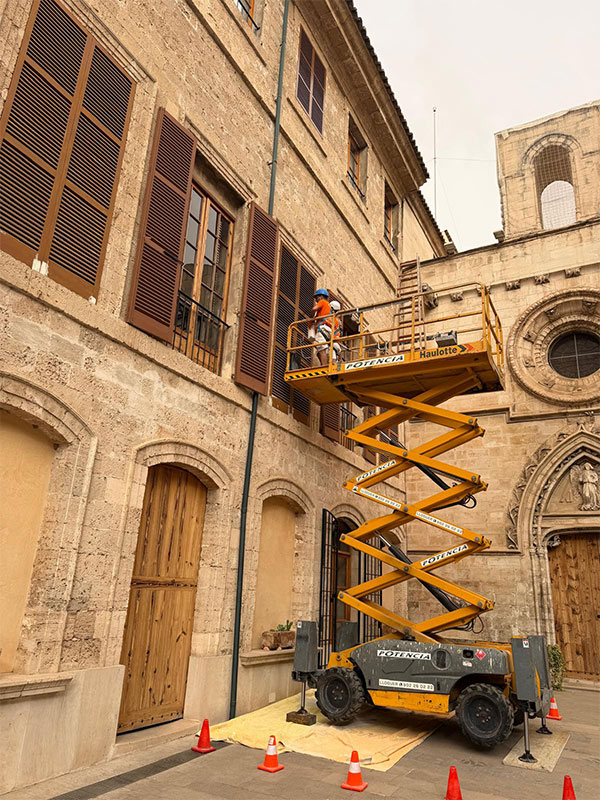
Shutter restoration carried out at the Consolat de Mar, in Palma


